
Pressure Gauges & Transmitters in Lahore, Pakistan
Pressure and vacuum gauges, diaphragm-seal gauges, digital gauges, pressure switches and transmitters for industrial processes.
Pressure measurement you can depend on
Pressure is one of the most important process variables in a plant. Gauges give operators a quick local reading, while transmitters and switches send pressure data to control systems and trigger alarms or shutdowns when limits are crossed.
A One Instruments supplies pressure and vacuum gauges, digital gauges, switches and transmitters for steam, water, air, oil and chemical services. If your process fluid is corrosive, hot, viscous or likely to clog, we can advise on diaphragm-type solutions.
What We Supply
Pressure instruments we supply
Pressure & vacuum gauges
General-purpose dial gauges for water, air, steam and oil systems, in pressure, vacuum and compound ranges. Simple, dependable local indication.
Diaphragm-type pressure gauges
Fitted with a diaphragm seal that isolates the gauge from the process. Designed for chemical, corrosive, viscous and crystallising media that would damage or block an ordinary gauge.
Digital pressure gauges & sensors
Digital-readout gauges and compact sensors that give easy-to-read, accurate pressure values where an analogue dial is hard to read precisely.
Pressure switches
Switch an alarm, pump or compressor on or off when pressure reaches a set point. Common on compressors, pumps, boilers and air systems.
Pressure transmitters (gauge and D/P)
Convert pressure into a standard electrical signal for PLCs and indicators. Differential pressure (D/P) transmitters measure the difference between two points and are used for flow across an orifice plate, level in closed tanks and filter monitoring.
Hydrostatic pressure transmitters
Measure the pressure of a liquid column to work out tank level, a simple way to monitor level in tanks and wells.
Process indicators & controllers
Panel-mounted digital displays that show pressure or temperature from a transmitter and can raise alarms or control at set limits.
How to choose a pressure gauge or transmitter
- Range: Choose a range where normal working pressure sits around the middle of the scale, with headroom for peaks, not near the top.
- Media: Corrosive, viscous or crystallising fluids call for a diaphragm seal; clean air and water can use a standard gauge.
- Accuracy: Critical measurements justify a more accurate instrument; general indication does not.
- Process connection: Match the thread size and type of your pipe or fitting.
- Dial size and mounting: Think about where operators will read it from and whether it is mounted on the line or a panel.
- Signal output: For transmitters, confirm the signal your PLC or indicator expects, commonly 4-20 mA.
Industries
Industries We Supply
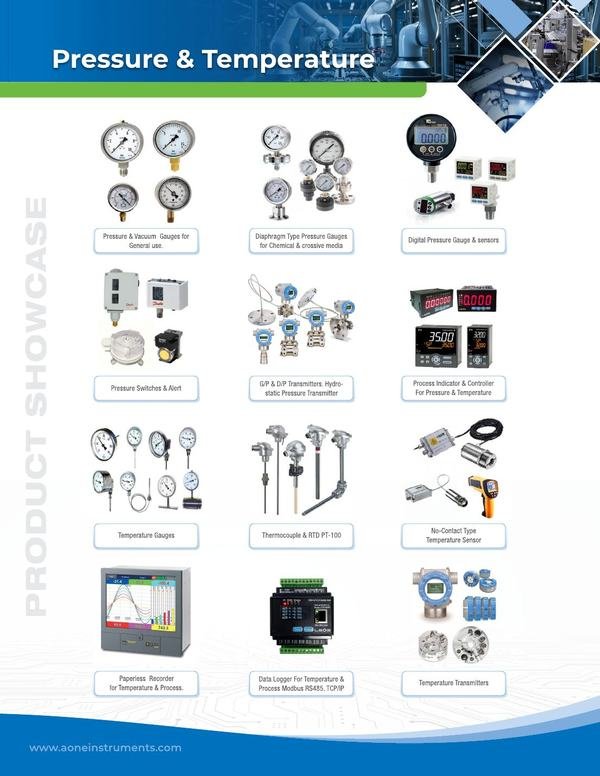
From Our Catalogue
See the Pressure & Temperature range
Our product catalogue shows photographs of each instrument type in this range. Browse every page online, or download the full catalogue as a PDF to keep for reference.
Why A One Instruments
Buy from a supplier you can rely on
Quality Assured
Genuine equipment from trusted global manufacturers, tested and calibrated.
20+ Years Experience
Hands-on experience across sugar, textile, paper, cement, food and more.
Calibration & Support
Calibration, maintenance and technical support to keep your instruments accurate.
Dispatch Across Pakistan
Nationwide dispatch and dependable after-sales support from our Lahore office.
FAQ
Pressure Gauges & Transmitters: Frequently Asked Questions
What is the difference between a pressure gauge and a pressure transmitter?
A gauge shows pressure locally on a dial or display. A transmitter converts pressure into an electrical signal, usually 4-20 mA, and sends it to a PLC, controller or recorder so it can be monitored and logged remotely.
What is a diaphragm seal pressure gauge used for?
A diaphragm seal keeps the process fluid away from the gauge mechanism. It is used with corrosive, viscous, sticky or crystallising media, and in sanitary processes, where an ordinary gauge would corrode or clog.
What is a differential pressure (D/P) transmitter?
A D/P transmitter measures the difference between two pressure points. Common uses are flow measurement across an orifice plate, level in closed pressurised tanks, and monitoring pressure drop across filters.
How do I select the pressure range for a gauge?
Pick a range where your normal operating pressure sits around the middle of the scale, with room for peaks. A gauge that runs constantly near its maximum wears faster and can lose accuracy.
How often should pressure gauges be calibrated?
It depends on how critical the measurement is and the operating conditions. Critical gauges are commonly checked at regular intervals, often yearly, while less critical ones may be checked less often. We offer calibration and testing services.
Related Products
You may also need
Temperature Sensors
Thermocouples, RTD PT-100, gauges, transmitters, recorders and data loggers.
View rangeFlow Meters
Electromagnetic, vortex, ultrasonic, turbine, Coriolis and thermal mass flow meters.
View rangeValves & Actuators
Control valves, actuators, positioners, ball, butterfly, globe and gate valves, steam traps.
View range
Looking for pressure gauges & transmitters?
Send us your requirement and our team will recommend the right product and send you a quotation.
Request a Quote