
Temperature Sensors & Transmitters in Lahore, Pakistan
Thermocouples, RTD PT-100 sensors, temperature gauges, transmitters, non-contact sensors, recorders and data loggers.
Accurate temperature measurement for process control
Temperature affects product quality, energy use and equipment safety in almost every industry, from boiler houses and dyeing machines to dryers, ovens and cold rooms. Choosing the right sensor, and pairing it with the right display, transmitter or recorder, is what turns a temperature reading into reliable control.
A One Instruments supplies contact and non-contact temperature instruments, along with the transmitters, recorders and data loggers that bring the readings into your control and monitoring systems.
What We Supply
Temperature instruments we supply
Thermocouples
Rugged sensors that cover a wide temperature range, suited to furnaces, ovens, boilers and high-temperature processes. Fast response and simple construction.
RTD PT-100 sensors
Resistance temperature detectors with a resistance of 100 ohms at 0 degrees C. Known for accuracy and long-term stability over moderate temperature ranges, and common in food, pharmaceutical and chemical processes.
Temperature gauges
Dial-type thermometers for local temperature indication on pipes, vessels and machines.
Temperature transmitters
Convert the signal from a thermocouple or RTD into a standard 4-20 mA output that travels long cable runs to a PLC or controller more reliably than a raw sensor signal. Head-mount and rail-mount styles are available.
Non-contact temperature sensors
Infrared sensors and thermometers that measure surface temperature from a distance. Useful for moving parts, hot surfaces, electrical panels and places where touching the target is unsafe or impractical.
Paperless recorders
Digital screen recorders that log temperature and other process signals without paper charts, so data is easy to view, store and export.
Data loggers
Compact units that record temperature and process signals and connect over Modbus RS-485 or TCP/IP for monitoring and reporting.
Process indicators & controllers
Panel instruments that display temperature and switch heaters, valves or alarms based on set points.
How to choose a temperature sensor
- Temperature range: Check the minimum and maximum temperature, including start-up and upset conditions.
- Accuracy: RTDs are generally preferred where accuracy and stability matter; thermocouples where the range is high.
- Response time: Fast-changing processes need a sensor with a quick response.
- Environment: Vibration, moisture and corrosive media may need a protective thermowell or sheath material.
- Mounting and insertion length: Match the pipe or vessel connection and the depth the sensor must reach.
- Output: Use a transmitter if the signal must travel far or feed a PLC, controller or logger.
Industries
Industries We Supply
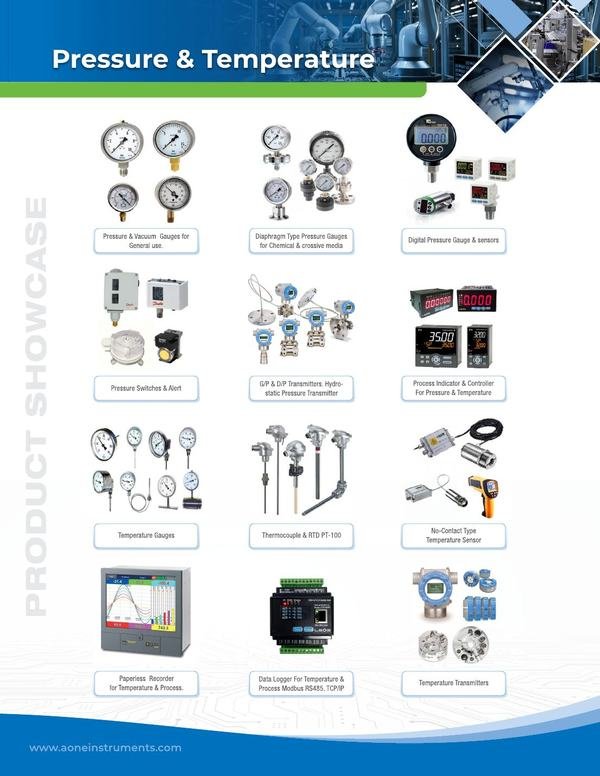
From Our Catalogue
See the Pressure & Temperature range
Our product catalogue shows photographs of each instrument type in this range. Browse every page online, or download the full catalogue as a PDF to keep for reference.
Why A One Instruments
Buy from a supplier you can rely on
Quality Assured
Genuine equipment from trusted global manufacturers, tested and calibrated.
20+ Years Experience
Hands-on experience across sugar, textile, paper, cement, food and more.
Calibration & Support
Calibration, maintenance and technical support to keep your instruments accurate.
Dispatch Across Pakistan
Nationwide dispatch and dependable after-sales support from our Lahore office.
FAQ
Temperature Sensors: Frequently Asked Questions
What is the difference between a thermocouple and an RTD?
A thermocouple generates a small voltage that changes with temperature. It handles a very wide, high-temperature range, responds quickly and is rugged. An RTD measures temperature through changing electrical resistance and is generally more accurate and stable over time within its range, but is typically used at lower maximum temperatures than a thermocouple.
What does PT-100 mean?
PT-100 is the most common type of RTD. It is made of platinum (Pt) and has a resistance of 100 ohms at 0 degrees C, which rises in a predictable way as temperature increases.
When should I use a non-contact temperature sensor?
Non-contact (infrared) sensors are useful when the target is moving, very hot, hard to reach or electrically live, or when a probe cannot be inserted. They measure surface temperature, so readings depend on the surface material and condition.
What is a temperature transmitter used for?
A temperature transmitter converts the small signal from a thermocouple or RTD into a standard 4-20 mA signal that can be sent over long cable runs to a PLC, controller or indicator with less interference.
What is a paperless recorder?
A paperless recorder is a digital replacement for chart recorders. It records temperature and other process signals to memory and shows them on a screen as trends, so data can be reviewed and exported without paper or pens.
Related Products
You may also need
Pressure Gauges & Transmitters
Pressure and vacuum gauges, diaphragm gauges, switches and D/P transmitters.
View rangePLCs & HMI
PLCs, HMI & SCADA, Ethernet I/O, gateways and custom control panels.
View rangeSensors & Power Supplies
Proximity and photo sensors, encoders, load cells, gas detectors, pH meters and power supplies.
View range
Looking for temperature sensors?
Send us your requirement and our team will recommend the right product and send you a quotation.
Request a Quote